
What Is Tai Chi Walking for Seniors? (Quick Answer)
Tai chi walking is a slow, mindful form of walking that applies tai chi principles — deliberate weight shifting, controlled breathing, and full-body awareness — to every step you take. Unlike regular walking, each footfall is intentional: heel first, rolling through the foot, with your gaze forward and your weight transferred smoothly from leg to leg.
It takes 5–10 minutes a day, needs no equipment, and can be done indoors or outdoors. Research shows it can significantly improve balance, reduce fall risk, and lower stress in older adults.
Key takeaway: Tai chi walking is essentially a moving meditation that trains your body to stay upright, respond faster to stumbles, and move with confidence — skills that matter more the older we get.
Why Balance Declines with Age — and Why That’s Dangerous
Falls are the leading cause of injury-related death among adults over 65 in the United States, according to the CDC. Every year, about 3 million older adults are treated in emergency departments for fall injuries. That’s not a small problem — it’s a public health crisis.
The biology behind it is straightforward. After age 50, muscle strength drops by roughly 1–2% per year. Reaction time slows. The inner ear, which helps regulate balance, loses sensitivity. Joints stiffen, narrowing the range of motion needed to recover from a stumble. Add medications that cause dizziness, or a home with uneven floors, and the risk compounds quickly.
What makes tai chi walking uniquely effective is that it targets all three physical systems responsible for balance:
- The musculoskeletal system (leg and core strength)
- The vestibular system (inner ear equilibrium)
- Proprioception (your body’s sense of position in space)
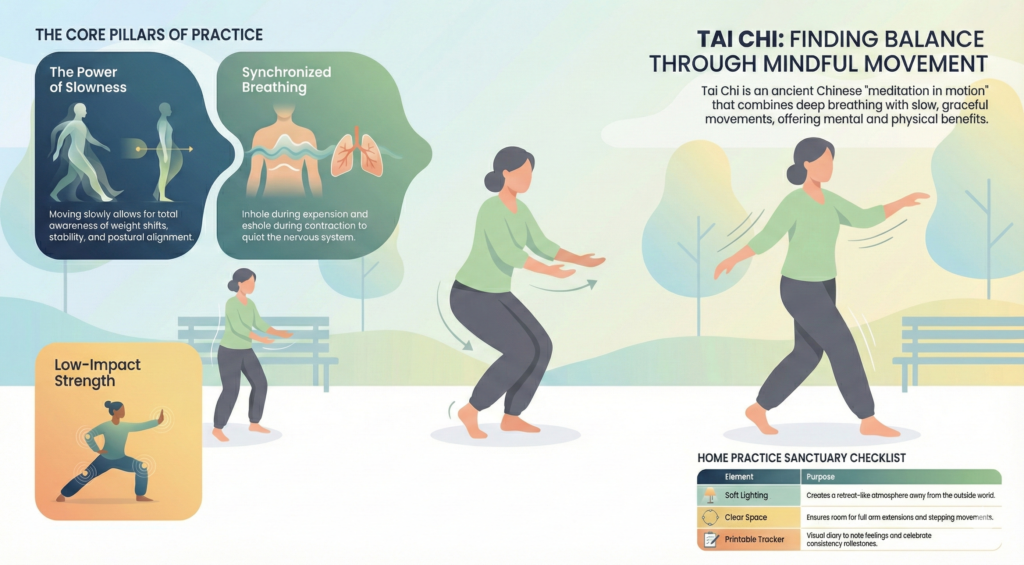
What the Research Actually Says
The science behind tai chi and balance is robust and growing. Here are the key findings:
Tai Chi Reduces Fall Risk
A 2023 meta-analysis of 24 randomized controlled trials found that tai chi effectively reduces fall risk and improves balance in older adults, with benefits increasing with more frequent practice. This isn’t anecdote — it’s the highest level of scientific evidence available.
It Outperforms Conventional Exercise
A study based on 12 trials involving 2,901 participants found that seniors who practiced tai chi completed a 50-foot walking test 1.84 seconds faster, could maintain a one-leg stance 6 seconds longer with eyes open, and performed significantly better on the Timed Up-and-Go test — a standard measure of fall risk used by physical therapists worldwide.
Short Sessions Work
Researchers found that programs under 20 weeks with fewer than 24 total hours of practice still produced meaningful improvements in functional mobility and balance. You don’t need to train for months before seeing results.
Mental Health Benefits Are Real
A 2024 study published in Frontiers in Medicine found that tai chi also reduces fear of falling — a psychological factor that causes many seniors to become less active, which ironically increases their actual fall risk. Breaking that cycle matters enormously for healthy aging.
Bottom line: Multiple independent meta-analyses confirm that tai chi is one of the most evidence-supported interventions for balance and fall prevention in older adults. For seniors specifically, the data is stronger than for almost any other exercise type.
7 Proven Benefits of Tai Chi Walking for Seniors
1. Stronger Stabilizing Muscles
The slow, weight-bearing steps of tai chi walking engage your quadriceps, hamstrings, glutes, and deep core muscles with every step. Unlike fast walking or jogging, you’re never moving too quickly for your muscles to fire correctly — so the right muscles actually do the work instead of relying on momentum.
2. Sharper Proprioception
Proprioception is your body’s GPS — it tells your brain where each limb is without you having to look. Tai chi walking trains this system by forcing you to feel each phase of every step: heel strike, foot roll, toe push-off, weight shift. Over time, your nervous system gets faster and more precise at detecting and correcting off-balance moments.
3. Greater Joint Flexibility
The hip rotation and knee flexion built into each step gently stretch your hip flexors, hamstrings, and ankles — the joints most responsible for stable, confident movement. This is especially valuable if you spend long periods sitting, which shortens and stiffens exactly these muscles.
4. Improved Gait and Walking Speed
Research shows that regular tai chi practice leads to measurably faster walking times and better gait mechanics. Faster, more fluid walking is associated with lower fall risk, better cardiovascular health, and even longer lifespan.
5. Reduced Stress and Anxiety
When you focus on your breath and each deliberate step, your brain shifts away from rumination and into the present moment. This activates the parasympathetic nervous system — the body’s ‘rest and digest’ mode — which lowers cortisol, slows heart rate, and reduces the background tension many seniors carry without realizing it.
6. Cognitive Stimulation
Learning and repeating movement sequences engages working memory, attention, and coordination. Harvard Health has summarized evidence showing tai chi practice enhances executive function — the mental skills used in planning, problem-solving, and multitasking — beyond what physical exercise alone produces.
7. Better Sleep
Multiple studies link regular tai chi practice to improved sleep quality in older adults, likely through its combined effects on stress reduction, gentle physical fatigue, and circadian rhythm regulation.
How to Do Tai Chi Walking: Step-by-Step for Beginners
You don’t need a trainer, a studio, or any equipment. Here’s how to start today.
Before You Begin: Set Up Safely
✓ Choose a flat, well-lit area — indoors or outdoors both work.
✓ Wear flat, non-slip shoes with good support.
✓ Practice near a wall or sturdy chair until you feel confident.
✓ If you have chronic pain, joint replacements, or known balance problems, check with your doctor first.
Step 1 — Find Your Foundation (1 minute)
Stand with feet hip-width apart. Let your arms hang naturally. Soften your knees slightly — don’t lock them. Relax your shoulders away from your ears. Take three slow, deep breaths: inhale through the nose for 4 counts, exhale through the mouth for 6 counts. Feel the ground under your feet.
Step 2 — Shift Your Weight
Without moving your feet, slowly shift your weight entirely onto your left foot. Feel how the left foot presses into the floor. Your right foot should feel almost weightless. Hold for 3 seconds. Then shift to the right. Repeat 3–4 times before you start walking. This primes your stabilizing muscles and wakes up your proprioception.
Step 3 — The Tai Chi Step
Lift your right foot slowly and step forward, placing your heel down first. Pause. Now roll through the foot — heel, arch, ball, then toes. As your weight transfers forward, feel it travel smoothly from one leg to the other. Take about 3–4 seconds per step. That’s much slower than normal walking — and that’s exactly the point.
Step 4 — Add the Breath
Inhale as you lift and step. Exhale as your weight shifts forward. Let the breath drive the movement, not the other way around. If you find yourself holding your breath, slow down even more.
Step 5 — Continue for 5–10 Minutes
Walk slowly across the room and back. If you have space, walk in a large circle. Keep your gaze forward (not down at your feet — this trains your balance systems better). Think about nothing except the sensation of your feet, the rhythm of your breath, and the shifting of your weight.
Step 6 — End with Stillness
Stop walking. Stand still. Take five slow breaths. Notice how your body feels — the warmth in your legs, the steadiness of your balance, the quiet in your mind. This closing moment helps consolidate the neuromuscular learning that happened during practice.
5 Common Mistakes to Avoid
- Walking too fast. Speed defeats the purpose entirely. If it feels uncomfortably slow, you’re probably doing it right.
- Looking down at your feet. It’s tempting, but it reduces the balance challenge and strains your neck. Keep your gaze at eye level.
- Stiff arms. Let them swing gently, or hold them slightly away from your body. Rigid arms create tension that travels up into the neck and shoulders.
- Skipping the weight-shift warm-up. Those initial standing shifts activate your balance muscles and make the walking much more effective.
- Expecting immediate results. Balance improvement typically becomes noticeable after 3–4 weeks of consistent daily practice. Stick with it.
How to Build a Daily Practice That Sticks
The single most important factor in getting results from tai chi walking is consistency — not duration. Five minutes every day will do far more than 30 minutes once a week. Here’s how to make it stick:
→ Anchor it to an existing habit. Do it right after your morning coffee, or before your afternoon television program. Linking a new behavior to an established one dramatically increases follow-through.
→ Start with just 3 minutes. Remove all friction. Three minutes is so easy to say yes to that there’s almost no excuse not to do it. Most days, you’ll naturally continue past the three minutes.
→ Keep a simple log. A tick mark in your calendar for each day you practice is enough. Seeing a streak of marks is surprisingly motivating.
→ Practice outdoors when possible. Walking on uneven surfaces like grass or gravel is harder — and better for your balance system — than walking on smooth floors. Even a back porch or garden path works.
→ Invite a friend. People who exercise with a partner are significantly more consistent. One tai chi walking neighbor or family member makes it a social activity.
Tai Chi Walking vs. Yoga vs. Regular Walking: Which Is Best for Seniors?
All three are beneficial, and none of them are mutually exclusive. Here’s how they compare on the dimensions that matter most for seniors:
- Fall prevention: Tai chi walking leads. Its specific combination of slow weight-shifting and proprioceptive training directly targets the mechanics of falling.
- Flexibility: Yoga has a slight edge here, particularly for the hips, spine, and hamstrings. Many seniors benefit from combining both.
- Cardiovascular benefit: Regular walking wins if done briskly. Tai chi walking is low-intensity and is not a substitute for aerobic exercise.
- Accessibility: Tai chi walking is arguably the most accessible of all three. It requires no mat, no gym, no floor-based movement, and no special clothing.
The ideal senior fitness routine includes all three: tai chi walking daily for balance, yoga 2–3 times per week for flexibility, and brisk walking or swimming for cardiovascular health.
Frequently Asked Questions
Most seniors notice improved confidence on their feet and reduced feelings of unsteadiness within 3 to 4 weeks of daily practice. Measurable improvements in balance tests have been documented in studies as short as 8 weeks.
Generally yes — it’s one of the lowest-impact exercises available. The slow, controlled movements don’t pound the joints. However, if you have a knee replacement, severe osteoarthritis, or recent surgery, check with your orthopedic doctor or physical therapist before starting. They may recommend modifications to the depth of your knee bend.
Absolutely. A clear hallway or living room works perfectly. Aim for at least 10–15 feet of open space. If you’re limited on room, you can also practice in place by doing slow, controlled weight-shifting without forward movement.
Not to begin. The step-by-step guide in this article gives you everything you need to start safely today. However, once you’ve built the basic habit, a class or group session with a qualified instructor can significantly deepen your practice and correct any technique issues you might not notice on your own.
Physical therapy for balance typically targets specific deficits with structured exercises. Tai chi walking is a broader practice with similar goals. Many physical therapists actually recommend tai chi as a complement to or continuation of PT once a patient is discharged. It’s not a replacement for PT if you’ve had a fall or injury — but it’s an excellent maintenance practice.
Tai chi walking is one of the most well-researched, accessible, and effective things a senior can do to protect their independence. It takes five minutes, costs nothing, and works for people across a wide range of fitness levels — from those who are already active to those recovering from injuries or dealing with chronic conditions.
The research is clear: regular practice improves balance, reduces fall risk, supports mental health, and may even sharpen cognitive function. And unlike many interventions that promise results without delivering, tai chi has been tested in hundreds of randomized controlled trials across thousands of participants.
Start with five minutes today. Be patient. And in four weeks, pay attention to how much more confident you feel on your feet.
Ready to go deeper? Explore our guides on chair yoga for flexibility, fall-proofing your home, and the benefits of qigong for joint health.
