
In the quiet hum of our daily lives, where the noise of the world often drowns out our inner peace, there exists an ancient practice—a moving meditation that restores balance to the soul. Tai Chi, often described as “meditation in motion,” is more than just exercise; it is a tapestry woven from breath, focus, and gentle movement. For those seeking a sanctuary of calm within their own homes, having a set of printable Tai Chi exercises can be the first step on a journey toward physical grace and mental clarity.
Whether you are looking to soften the edges of a stressful day or simply wish to reconnect with the rhythm of your own body, this guide will walk you through the art of Tai Chi. We will explore its profound benefits, the poetry of its basic movements, and how you can weave this practice into the fabric of your daily routine with the help of simple, printable guides.
The gentle power of Tai Chi for stress relief
Imagine a willow tree swaying in the breeze—rooted deeply in the earth, yet flexible enough to dance with the wind. This is the essence of Tai Chi. Originating from ancient China, this martial art has evolved into a graceful form of exercise that is practiced across the globe for its health benefits.
For our community, where the pace of life can sometimes feel relentless—balancing work, family, and spiritual commitments—Tai Chi offers a necessary pause. It is a soft invitation to slow down. Unlike high-intensity workouts that demand force and speed, Tai Chi asks for softness and intention.
The benefits are as layered as a fine hand-knotted carpet. Physically, it enhances balance and flexibility, strengthening the body without strain. Mentally, it is a balm for anxiety. By focusing the mind on the breath and the flow of movement, the chatter of worries begins to fade, replaced by a sense of serene focus. It is a practice that respects the body’s limits while gently expanding them, making it suitable for every age and every season of life.
Understanding the basics: Slow movements and mindful breathing
Before you download your printable guide and begin, it is essential to understand the spirit of the movements. Tai Chi is not about getting from point A to point B; it is about the journey in between.
The art of slowness
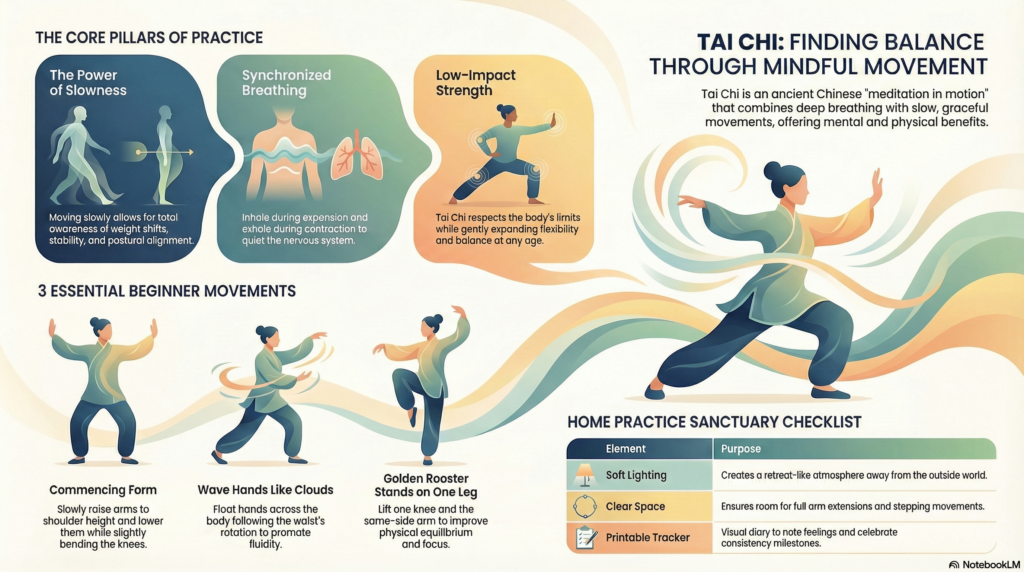
In Tai Chi, slowness is a strength. Moving slowly allows you to pay attention to the nuances of your body—the shift of weight from one foot to the other, the curve of the wrist, the lengthening of the spine. It is in this slowness that we find control and stability. It teaches us that we do not need to rush to be effective; we simply need to be present.
The rhythm of breath
Breath is the thread that stitches the movements together. In traditional practice, the breath is deep, natural, and rhythmic. As you expand your body or lift your arms, you inhale, drawing in energy. As you contract or lower your body, you exhale, releasing tension. This synchronization of breath and motion creates a harmony that resonates deep within, quieting the nervous system and grounding the spirit.
Top 5 printable Tai Chi exercises for beginners
To help you begin your practice, we have curated five fundamental movements. These can be easily followed on a printable sheet, allowing you to practice offline, free from the distraction of screens.
1. Commencing Form (Opening the Door)
Stand tall with your feet shoulder-width apart, knees slightly soft, and arms resting by your sides.
- The Movement: Slowly raise your arms in front of you to shoulder height, palms facing down, as if your wrists are being lifted by invisible strings. Gently lower them back down, bending your knees slightly as your hands descend.
- The Feeling: Visualize the beginning of a new day, the sun rising and setting. It grounds you and prepares the energy for the practice ahead.
2. Parting the Wild Horse’s Mane
- The Movement: Hold a conceptual “energy ball” between your hands (one high, one low). Step forward diagonally. As you shift your weight to the front leg, separate your hands—the lower hand sweeps up, and the upper hand presses down, passing each other like gentle clouds.
- The Feeling: This move opens the chest and invites confidence. It feels like spreading a heavy curtain to reveal a beautiful view.
3. Wave Hands Like Clouds
- The Movement: Stand with feet apart. Shift your weight to one side, turning your waist. Your hands float across your body, one at face level, one at waist level, following the rotation of your torso.
- The Feeling: Imagine you are standing in a stream, your hands tracing the surface of the water. It promotes flow and fluidity, washing away stagnant energy.
4. Golden Rooster Stands on One Leg
- The Movement: Lift one knee and the arm on the same side, while the other hand presses down. The standing leg remains slightly bent but strong.
- The Feeling: This posture embodies balance and focus. Like a rooster greeting the dawn, it is proud and stable, improving your physical equilibrium.
5. Grasping the Sparrow’s Tail
- The Movement: This is a sequence of four energies: Ward Off, Roll Back, Press, and Push. It involves coordinating the arms in a circle, shifting weight back to yield, and moving forward to express gentle power.
- The Feeling: It is the centerpiece of Tai Chi, combining defense and yielding. It teaches us to accept force and redirect it, rather than meeting it with resistance.
Creating a sanctuary: Your dedicated home practice space
Just as a weaver needs a loom, a Tai Chi practitioner needs a space that honors the practice. You do not need a vast studio; a small, quiet corner of your home is enough.
Choose a spot where the light is soft and the air flows freely. Clear away the clutter—physical clutter often leads to mental clutter. Perhaps lay down a soft rug, one that feels grounding underfoot, adding a touch of texture and warmth to your sanctuary.
Ensure you have enough room to step forward and extend your arms without obstruction. This space should be your retreat, a place where you can leave the demands of the outside world at the threshold. When you step into this space, you are signaling to your mind that it is time to return to yourself.
The beauty of consistency: Tracking progress with printables
The true magic of Tai Chi reveals itself not in a single session, but over time. It is a cumulative craft, much like the slow, intricate knotting of a carpet. Consistency is key.
Using a printable tracker can be a wonderful way to honor your commitment. It serves as a visual diary of your journey.
- Mark your days: There is satisfaction in checking off a day of practice, a small celebration of discipline.
- Note your feelings: Leave space on your printable to jot down how you felt before and after. Did your breath deepen? Did your shoulders soften?
- ** celebrate milestones:** Acknowledge when a movement that once felt awkward begins to feel like second nature.
By printing your exercises and your tracker, you create a tangible connection to your practice. You are not dependent on a battery or an internet connection; it is just you, the paper, and the movement.
Embrace the flow
Tai Chi is a gift of longevity and peace you give to yourself. It is a celebration of what the human body can do when treated with kindness and patience. As you move through these forms, remember that perfection is not the goal—presence is.
We invite you to download our guide, clear a small space in your living room, and begin. Let the movements be a conversation between your body and your breath.
[Download Your Free Printable Tai Chi Beginner’s Guide Here]
People Also Ask (FAQ)
Is Tai Chi difficult to learn for beginners?
Not at all. Tai Chi is designed to be accessible. While mastering the subtleties can take a lifetime, the basic movements are gentle and easy to follow. A printable guide allows you to learn at your own pace, pausing to understand the mechanics of each posture without pressure.
Do I need special clothing to practice Tai Chi?
Comfort is the priority. You should wear loose, breathable clothing that allows for a full range of motion—much like the comfortable cotton or cashmere garments you might wear for relaxation. Avoid tight waistbands or restrictive fabrics that might hinder your breath or movement.
Can I practice Tai Chi if I have limited mobility?
Yes, Tai Chi is incredibly inclusive. Many exercises can be adapted or even performed while seated. The focus remains on intention, breath, and upper body flow, providing health benefits regardless of physical limitations.
How often should I use my printable Tai Chi exercises?
Ideally, a little every day is better than a lot once a week. Even 10 to 15 minutes of daily practice can significantly lower stress levels and improve balance. Keep your printable guide visible—perhaps on a noticeboard or near your practice mat—as a gentle reminder to take that time for yourself.
