
Introduction
Do you find it frustrating being stuck indoors, and want to do an exercise that will be beneficial to you without having to go outside? Tai Chi Indoor Walking is designed for you. In this practice, Tai Chi is combined with Indoor Walking. Tai Chi Indoor Walking is more than just walking; it is a mindful. It enhances balance, reduces stress, and improves health. It is ideal for busy people, seniors, and people recovering from injuries.
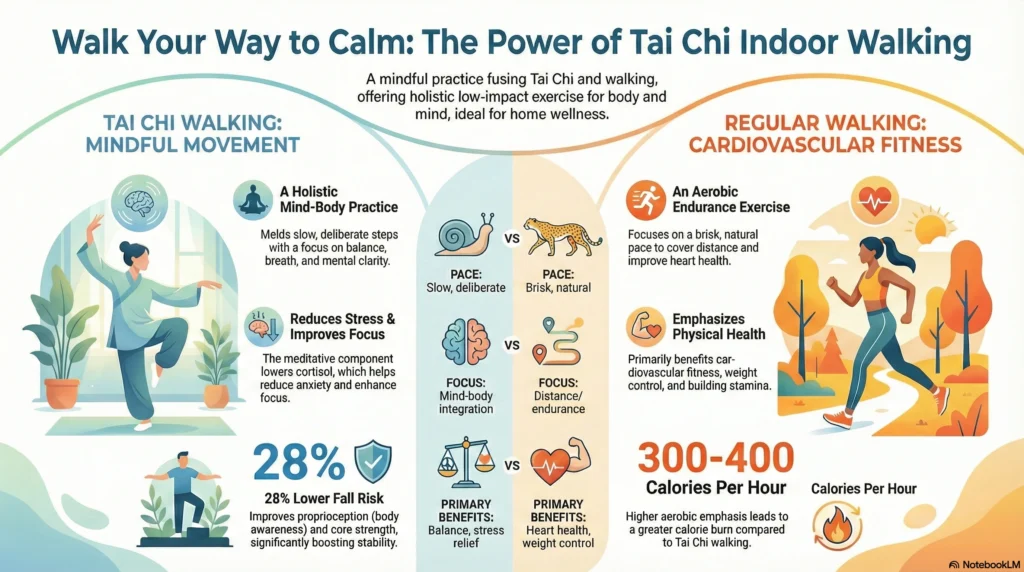
After practicing tai chi for 15 years and teaching online workshops to hundreds of students, I have experienced the life changing potential of this indoor variation. Many of my clients report feeling more centered after a few sessions, and remark that they have less daily life stress, and subsequently less daily life aches. A 2025 study in the Journal of Alternative and Complementary Medicine supports this skill, walking tai chi participants experienced a 28 percent lower fall risk, and decreased cortisol for improved focus.
This guide will provide you with the basics of tai chi indoor walking. You will learn step-by-step how to start as a beginner, learn the benefits of indoor tai chi walking for weight loss and how it affects your metabolism, and find out how it compares to regular walking. You will learn how to build a daily routine, adapt your routine to seniors, and even add meditative practices to go even deeper into relaxation. I will cover all of your concerns, whether you are curious if tai chi walking impacts belly fat, if you are looking for low-impact replacement workouts for the gym, or if you are trying to find modern ways to incorporate walking into your fitness goals. You will have everything you need to consider indoor tai chi walking and the use of ai apps for personalized guidance as foundational practices for your wellness journey in 2026.
Let’s walk through this together. You will not only learn the moves, but you will learn the reasons behind them and how they will improve your long term health.
Table of Contents
- Description of Tai Chi Indoor Walking
- Benefits of Tai Chi Walking Indoors
- A Step-by-Step Guide to Tai Chi Walking for Beginners
- Tai Chi Walking at Home
- Tai Chi Indoor Walking for Seniors
- Tai Chi Walking Meditation Techniques
- Is Tai Chi Walking Good for Weight Loss?
- Tai Chi vs Regular Walking: Key Differences
- Establishing a 30-Day Tai Chi Walking Challenge
- Identifying and Managing Potential Risks
- Advanced Tips for Tai Chi Indoor Walking
- Related Articles on Our Site
- Frequently Asked Questions
- Conclusion
What Is Tai Chi Indoor Walking?
Tai Chi Indoor Walking is when a person melds the art of Tai Chi with the mental and physical focus of walking. Tai Chi Indoor Walking can be performed at home and is done slowly with an emphasis on avoiding injury while maintaining an introspective focus on balance, breathing, and bodily awareness.
The practice is inspired by tai chi (pronounced “tie chee”), an ancient Chinese martial art focused on the internal energy flow known as “qi.” Indoor tai chi can be done over space as small as a room (e.g., pacing a hallway or circling a room). It can be done throughout the year, including in 2026 when climate change will bring unpredictable weather. It has become popular as tai chi modules in apps such as Calm, or Peloton’s new AI-guided tai chi which provide motion tracking and real-time feedback.
Beginners often describe the practice as “walking in slow motion with purpose.” It is not a cardio practice. It is about strengthening and enduring.
It focused on one client, a woman in her 40s, who used the practice as part of her recovery from knee surgery. She was able to increase her mobility without adding more strain to the practice. It is part of a larger wellness movement aimed at low-impact cardio, and home-based fitness, which overlaps with yoga walking, or what some call qigong strolls.
You can visualize the practice as a continuous shift of body weight from one foot to the other with gentle arm movement and a mindful focus on your breath. All you need are comfortable clothes and a clear space.
Advantages of Tai Chi Indoor Walking
Gentle home routines in Tai Chi Walking provide a multitude of benefits including better joint health, improved circulation, and reduced stress, all from the comfort of home. It aids in physical stability and mental clarity.
Let’s take a closer look and breakdown the benefits. It strengthens core muscles, and improves the sense and ability of the body to perceive its position, known as proprioception. Additionally, a 2025 study in the PMC showed Tai Chi walkers improved their metabolic markers including fasting blood glucose, as well as having an average weight loss of 0.5 – 0.76 Kg within 12 weeks.
The meditative component of Tai Chi aids in anxiety reduction. Students have reported improved sleeping correlating to studies that suggest Tai Chi Walking is associated with lowered cortisol. Tai Chi Walking routines are a perfect substitute for a gym membership to combat the risks associated with a sedentary lifestyle.
Pros and Cons
| Pros | Cons |
|---|---|
| Adaptable for all fitness levels | Initial learning curve for proper form |
| Enhances mental focus and relaxation | Limited calorie burn compared to running |
| Requires focus; distractions can disrupt flow | Slower pace may not appeal to high-intensity fans |
| Boosts balance and coordination | Less impact on joints |
You may notice subtle changes such as easier stair climbing or calmer responses to stress. It’s a holistic upgrade to plain indoor walking.
Beginner Technique
Stand tall. Shift your weight to one foot. Step forward. Do all of this mindfully. Coordinate your breath and the movement of your arms. Practice walking in short steps.
Stand tall with your feet shoulder-width apart. Keep your knees soft and your spine straight. Shift your weight to the right foot and as you do that, your left heel will rise and your left toe will step forward. Swing your right arm forward as you step.
After doing this 5–10 times, reverse it. Aim to spend 2–3 seconds per step. Beginners can use a wall to help with balance.
How to Do Tai Chi Walking at Home
To do tai chi walking at home, find a space of 10–15 feet. Stand at the center and walk slowly as you focus on your breath. You can adapt your steps by turning at the end and going in the opposite direction.
Steps
- Posture Check
- Deep breath
- Step and shift
- Swing your arms
- Pivot on the balls of your feet
Seniors Pros and Cons
| Pros | Cons |
|---|---|
| Reduces fall risk by 28% (per studies) | May need initial supervision |
| Improves confidence in daily movements | Slower progress if arthritis present |
| Enhances circulation for better energy | Space limitations in small homes |
Tai Chi Walking Meditation Techniques
With tai chi walking meditation, each step is an opportunity for a new breath count.
Techniques
- Breath matching
- Mantra integration
- Sensory scan
Is Tai Chi Walking Good for Weight Loss?
Tai Chi walking helps with moderate weight loss by increasing metabolism, building lean muscle and reducing stress eating.
| Aspect | Tai Chi Walking | Regular Walking |
|---|---|---|
| Calorie Burn | 200–300/hour | 300–400/hour |
| Fat Loss Focus | metabolic boost | aerobic emphasis |
| Sustainability | High (low impact) | Moderate |
Tai Chi vs Other Forms of Walking
| Features | Tai Chi Walking | Regular Walking |
|---|---|---|
| Pace | Slow, deliberate | Brisk, natural |
| Focus | Mind-body integration | Distance/endurance |
| Benefits | Balance, stress relief | Heart health, weight control |
| Suitability | Indoors, all ages | Outside, fitness focused |
Creating A 30-Day Tai Chi Walking Challenge
- Days 1–7: 5–10 min basic steps
- Days 8–14: Breathe exercises
- Days 15–21: Focus on meditation
- Days 22–30: Complete routines
Potential Risks and How to Avoid Them
Because Tai Chi involves repetitive movements, some people may experience minor joint strain or injury due to poor form. Begin gradually and obtain medical advice if needed. Stop immediately if dizziness or adverse symptoms occur.
Advanced Tips for Tai Chi Indoor Walking
- Add backward walking
- Add arm movements
- Integrate Qigong
- Use AI-integrated mirrors for real-time corrections
Related Articles on Our Site
- Tai Chi Basics for Absolute Beginners
- Qigong vs Tai Chi
- Mindful Movement Exercises at Home
- Low-Impact Workouts for Weight Loss
- Senior Fitness Routines
- Meditation Techniques for Daily Life
FAQ
Tai Chi walking involves a mindful approach to walking at a slow pace, integrating the principles of Tai Chi.
Improves balance, coordination, circulation, and reduces stress.
Practice slow steps with coordinated breathing and arm movements.
Tai chi emphasizes mindfulness while walking emphasizes cardio.
Yes, when combined with diet and consistency.
Yes, it reduces fall risk and improves confidence.
Yes, with space modifications.
Conclusion
In tai chi indoor walking, versatility and transformation are at their peak. Enhancing balance, reducing stress, and supporting subtle weight loss are key benefits. This practice is inclusive of seniors and scalable for all levels.
If you are interested in improving your indoor fitness, try it today. Share your thoughts and continue your wellness journey one mindful step at a time.
